Car insurance abroad: where are you covered?
Does your Belgian car insurance cover you abroad? RC, omnium, assistance, excluded countries like Russia: what your green card really covers on a trip.

Key takeaways
- Belgian third-party liability (RC) automatically covers you in the ~48 countries listed on your international insurance certificate, the former green card.
- Your own damage is only covered abroad if you have omnium or mini-omnium; breakdown assistance is a separate add-on.
- Russia and Belarus left the system in June 2023, Iran has been suspended since 1 January 2024: you need border insurance on the spot.
You pack the bags, the boot is full, the GPS points south. One question few Belgian drivers ask before setting off: does your insurance really follow you across the border? Yes for the essentials — compulsory third-party liability covers you automatically across most of Europe. But omnium, assistance and a few countries like Russia follow other rules. Here is which.
Does your Belgian insurance automatically cover you abroad?
Yes, for third-party liability. RC, the only compulsory cover in Belgium, protects you in every country shown on your international insurance certificate, with no formality or surcharge. This cover follows you the moment you cross the border, whether you nip to Lille for a day or spend three weeks in Croatia.
This cover rests on the law of 21 November 1989 on compulsory motor liability insurance, and on an international agreement between national insurance bureaus. In practice, when you cause an accident in France or Spain, it is the green card system that guarantees the victim will be compensated under local law, with your Belgian company settling the bill afterwards.
What few people know: this cross-border RC works even if you never asked for a specific document. Any valid Belgian RC contract includes cover for the zone countries by default. That is where free cover stops: RC pays the damage you cause to others, never the damage to your own car. For that, back to RC, mini-omnium or omnium.
Which countries are covered by the international insurance certificate?
The international insurance certificate is the document, long called the green card, that proves your vehicle is insured for RC abroad and lists the countries where this cover is recognised. In Belgium it is issued by your insurer under the control of the Belgian Bureau of Motor Insurers (BBAA).
The zone covers nearly 48 territories: the 27 EU states, plus the UK, Switzerland, Norway, Iceland, Liechtenstein, Andorra, Monaco, San Marino, the Vatican, Serbia, Montenegro, North Macedonia, Bosnia and Herzegovina, Albania, Morocco, Tunisia, Israel and Turkey. In short: every classic holiday destination for a Belgian motorist is in there.
Beware of territorial exceptions. Several "disputed" zones are expressly excluded by the Council of Bureaux that runs the system: Kosovo, the northern part of Cyprus, Crimea, Nagorno-Karabakh, and the West Bank and Gaza Strip. Driving there means driving without valid RC.
Is the green card still green?
Not necessarily. Since July 2020, the document can be printed in black and white on plain paper, or even shown as a PDF on your smartphone. Its legal value is identical. People still often call it the "green card" out of habit, but its official name is now the international insurance certificate. Always keep a legible copy with you: some checks outside the European Union still ask for paper.
What to do for Russia, Belarus or Iran?
These three countries have left the circuit. Russia and Belarus left the green card system in June 2023; Iran has been suspended since 1 January 2024. Your green card no longer has any value there.
Omnium or RC: which cover for your own damage abroad?
RC never repairs your car, neither in Belgium nor anywhere else. To cover your own damage abroad, you need omnium or mini-omnium, which in principle follow the same geographic area as RC.
Mini-omnium covers specific risks whatever your degree of responsibility: theft, fire, broken glass, natural disasters, collision with an animal. Full omnium adds material damage even when you are at fault, for example if you hit a crash barrier on an Italian mountain road. To place these two formulas, read our comparison of omnium vs mini-omnium in Belgium.
The point to check before leaving: the exact area of your omnium. Some contracts limit material damage to geographic Europe and exclude Morocco, Tunisia or the Asian part of Turkey, even though these countries appear on the green card for RC. Read your policy terms, not the sales leaflet.
| Situation abroad | RC only | Mini-omnium | Full omnium |
|---|---|---|---|
| Damage caused to third parties | Yes | Yes | Yes |
| Theft, fire, broken glass | No | Yes | Yes |
| Damage to your car, at-fault accident | No | No | Yes |
| Breakdown and towing | Add-on | Add-on | Add-on |
The table shows the essential: even with full omnium, breakdown assistance stays a separate cover. It is the most common mistake I used to see in the office.
Is breakdown assistance included when you break down abroad?
No, not automatically. Assistance is an optional cover, separate from RC and omnium. Without it, neither towing your broken-down car on a Portuguese motorway nor a replacement vehicle is covered.
On the Belgian market, this add-on generally costs between €30 and €80/year depending on the scope (Belgium only or Europe + travel assistance). Depending on the contract, it covers towing to the nearest garage, vehicle repatriation, emergency accommodation and sometimes a category-B replacement vehicle for a few days.
From what distance is assistance triggered?
That is the classic trap. Many assistance formulas only activate beyond a certain distance from your home, often around 25 to 50 km. Breaking down 10 km from home can therefore leave you without recovery, while the same breakdown in Spain would be covered. "0 km" formulas, which assist you even outside your door, exist but cost more. Read this clause before signing.
Do Touring or VAB overlap with my insurer?
Often, yes. If you are already a member of an assistance provider like Touring or VAB, you may already have Europe-wide recovery. There is then no point paying for a second assistance through your car insurer. Compare the two contracts — area covered, limits, repatriation — and keep the one that best fits your real use.
Do you need border insurance or a temporary extension?
It all depends on your destination and the duration. For a country not on the green card, border insurance bought on the spot is the only valid option. For an unusual stay, temporary insurance takes over.
Belgian temporary car insurance covers a vehicle for 1 to 90 days maximum, with cover close to a standard contract. It is useful for an imported vehicle, a one-off trip with a car not insured year-round, or a long stay abroad. For green card countries, your usual contract is enough: a "temporary" holiday stay needs no extension.
Before a big departure, the useful reflex is to tell your insurer the itinerary and duration, and to compare what the cover is really worth from one contract to another. That is exactly the point of browsing our Belgian car insurance guides before the holiday rush rather than on the way back, bill in hand.
The documents to take before leaving
Three papers head off 90% of the hassle at a check or after a knock. Keep them together, in the glovebox.
The international insurance certificate (former green card), up to date and covering the whole trip. The European accident statement, identical in every signatory country, to be filled in on the spot after a collision. And of course your driving licence, the registration certificate and your ID card. For a vehicle that is not yours, add written authorisation from the owner.
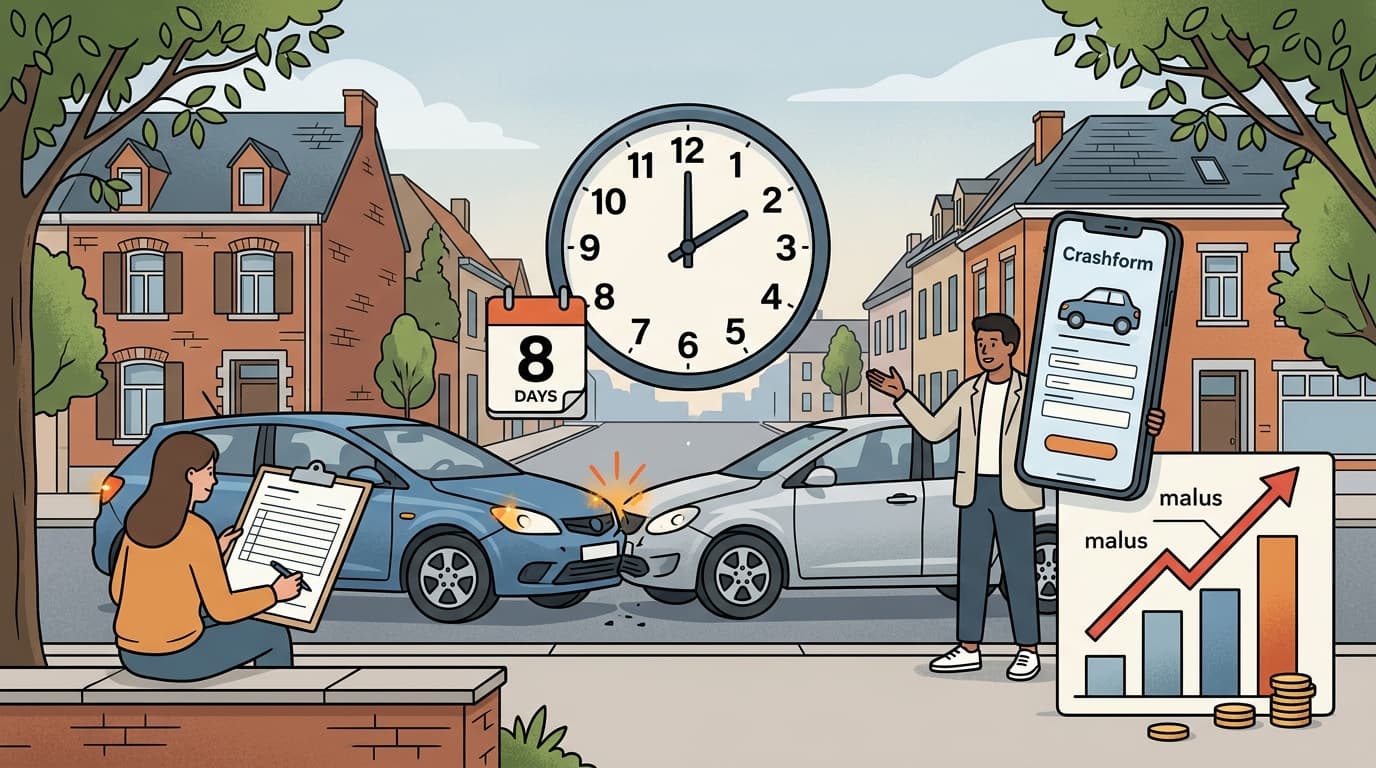
If you have an accident, fill in the statement before leaving the scene, take photos, and report the claim to your Belgian insurer as soon as you return, within the deadline set in your contract. It is your Belgian company that handles the file, wherever the accident happened in the zone.
Frequently asked questions
Continue reading

Thomas R.
A former FSMA-licensed insurance broker, Thomas Renard has analysed and compared Belgian car insurance contracts since 2014. He has helped over 2,000 drivers choose their cover.